How to catch Atlantic goldeneye tilefish
Caulolatilus chrysops (Valenciennes, 1833)
About Atlantic goldeneye tilefish fishing
The Atlantic goldeneye tilefish is a marine ray-finned fish belonging to the family Malacanthidae, found in the western Atlantic Ocean over rubble bottoms of shell and coral fragments. It features a sturdy, quadrangular body with a violet hue, a pale yellow tint on the back, a silvery sheen on the lower flanks, and a distinctive bright yellow streak running from beneath the eye to the nostrils accompanied by a blue line. Growing to a maximum total length of sixty centimetres with a more common length of forty-four centimetres, this demersal species inhabits deeper waters ranging from seventy-six to two hundred and forty-four metres. It forages on or just above the substrate, feeding primarily on crustaceans and other invertebrates alongside small fishes, and is known to be a remarkably long-lived species reaching ages of thirty to thirty-five years.
-
Difficulty
Medium
-
Average size
44 cm TL
-
Market value
Very high
-
Habitat
Saltwater
-
Also known as
Atlantic goldeye tilefish, Goldface Tilefish, Goldface tilefish

Golden eye margin
Bright golden-yellow ring around the eye distinguishes this tilefish species.
Spotted caudal fin
Yellow caudal fin bears distinct small orange spots across its membrane.
Blue facial stripe
Iridescent blue stripe curves below the eye across the golden cheek.
Atlantic goldeneye tilefish fishing facts
Characteristics
-
Typical size
44 cm TL (max 60 cm TL ) -
Typical weight
0.4 kg (max 2.4 kg ) -
Preferred temperature
17.1–25.2 °C -
Depth
76–244 m -
Longevity
35 years -
Body shape
Fusiform / Normal -
Commercial?
-
Vulnerability score
48.8
How to catch Atlantic goldeneye tilefish
Tips for catching Atlantic goldeneye tilefish
Targeting this deep-dwelling demersal species requires heavy bottom-fishing tackle capable of reaching soft substrate zones far offshore. Anglers deploy multi-hook drop rigs weighted with heavy leads to maintain contact with the seabed over shell and coral rubble layers. Fresh cut strips of squid or oily fish serve as the most effective presentations, appealing directly to the bottom-feeding habits of the fish. Patience is essential when waiting for a bite at significant depths, and managing boat drift helps cover productive bottom structure efficiently.
Other names for Atlantic goldeneye tilefish
Local and alternate names anglers use for Atlantic goldeneye tilefish.
-
Atlantic goldeneye tilefish
-
Goldface tilefish
-
Atlantic goldeye tilefish
Best equipment to catch Atlantic goldeneye tilefish
Compare fishing methods for Atlantic goldeneye tilefish — sized kit for each technique.
Note: Typical fish is 0.4 kg Our algorithm will suggest the best equipment for you based on this weight.
Bottom Fishing
Presenting bait or rigs on or near the lake or sea floor.
90% Effectiveness

Rod
Spinning rod
A spinning rod is a fishing rod built to carry a spinning reel under the blank. You cast lures and light baits with it from shore or a boat.
Sized for a typical fish
light · 2.1 m
- Reel seat
- Spinning
- Form factor
- Multi-piece
- Action
- Fast
- Grip
- EVA

Reel
Spinning reel
A spinning reel hangs under the fishing rod and is the default reel for casting lures and light baits. Line peels off an open spool with a bail.
Sized for a typical fish
1000 · 3 kg drag · 185 g
- Spool
- Fixed
- Mount
- Under
- Drag
- Front
- Retrieve
- Manual

Line
Monofilament line
Monofilament fishing line is the everyday main line: easy to knot, cheap to replace, and stretchy enough to forgive a hard strike.
Sized for a typical fish
2.5 kg · 0.16 mm
- Visibility
- Medium
- Abrasion
- Medium
- Stretch
- High
- Sink rate
- Slow

Leader
Fluorocarbon leader
A fluorocarbon leader is the clear, fast-sinking join between a visible main line and the lure or hook.
Sized for a typical fish
4 kg · 0.2 mm · 80 cm
- Visibility
- Very low
- Abrasion
- High
- Stretch
- Low
- Sink rate
- Fast

Hook
Circle hook
A circle hook turns in the mouth and usually finds the corner of the jaw. You do not strike hard — you come tight. It includes freshwater.
Sized for a typical fish
4
- Points
- 1
- Offset
- No
- Barbed
- Yes
- Gap
- Standard
Best lures and baits for Atlantic goldeneye tilefish
Ranked lures and natural baits from every method, best first.
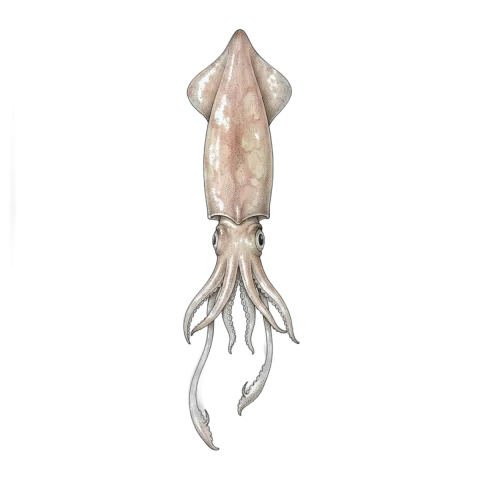
01
Squid
- Bottom Fishing
Elongated muscular body holds internal organs and secretes scent in the water.
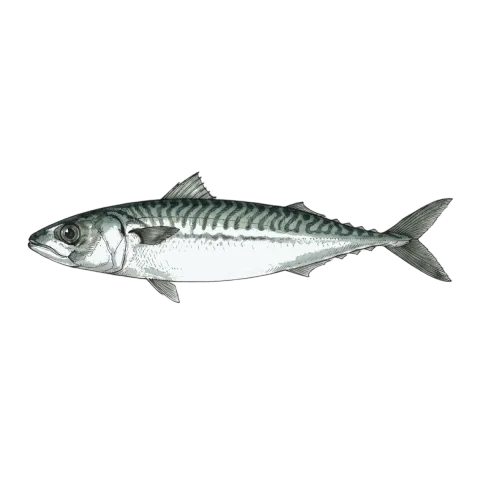
02
Mackerel
- Bottom Fishing
Distinctive wavy dorsal stripes provide high contrast and flash underwater.
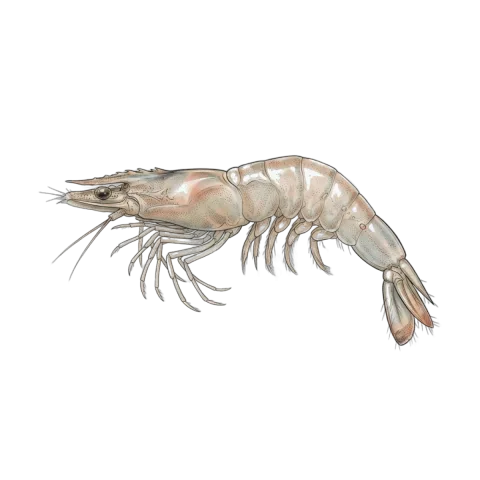
03
Shrimp
- Bottom Fishing
Translucent segmented carapace protects the body.
Diet and behavior of Atlantic goldeneye tilefish
-
Diet
Carnivore -
Feeds by
Mixed feeder
Prey and predators of Atlantic goldeneye tilefish
Prey is what Atlantic goldeneye tilefish eats. Predators are the animals that eat it.
That is how it feeds, and how it is hunted.
Prey
What it eats
Other prey
Where Atlantic goldeneye tilefish lives
Lives on or just above the bottom. Work jigs, bait, and lures along the seabed.
76–244 m

Where this species lives
Atlantic goldeneye tilefish photos for identification
Compare these photos with the catalog plate to identify the species.