How to catch Prickly puffer
Ephippion guttifer (Bennett, 1831)
About Prickly puffer fishing
The prickly puffer is a robust marine fish belonging to the family Tetraodontidae, characterized by its fusiform body shape and the unique ability to inflate its body and erect prominent spines when threatened. Growing up to a maximum length of 80 centimetres, this demersal species inhabits shallow coastal waters, estuaries, bays, and lagoons over hard substrates across the eastern Atlantic. It feeds primarily on benthic macrofauna including crabs, echinoids, and hard-shelled mollusks using its powerful beak-like teeth. Valued in commercial fisheries and recognized as a gamefish, it offers an exciting challenge for specialized anglers exploring inshore marine habitats.
-
Difficulty
Medium
-
Average size
55 cm TL
-
Market value
Very high
-
Habitat
Brackish, Saltwater
-
Season
Spring, Summer, Autumn
-
Also known as
Common puffer, Globefish, Pricky puffer, Swamp

White Spots
Numerous small white spots scattered across the body distinguish this puffer.
Prickly Skin
Small prickles covering the body characterize this specific puffer species.
Prickly puffer fishing facts
Characteristics
-
Typical size
55 cm TL (max 80 cm TL ) -
Typical weight
0.4 kg (max 4.3 kg ) -
Preferred temperature
19.2–27.9 °C -
Depth
10–100 m -
Body shape
Fusiform / Normal -
Commercial?
-
Vulnerability score
49.2
Best hours
-
Low
Dawn
First light
-
Peak
Morning
After sunrise
-
Peak
Midday
High sun
-
Active
Afternoon
Late day
-
Low
Dusk
Last light
-
Low
Night
After dark
When to fish for Prickly puffer
How to catch Prickly puffer
Tips for catching Prickly puffer
Targeting this heavy-jawed benthic predator requires robust tackle capable of withstanding sharp shells and powerful crushing bites. Anglers should focus their efforts around rocky outcrops, structured reefs, and estuary mouths where hard bottoms provide abundant crabs and mollusks. Presenting natural baits directly on the sea floor using heavy sliding ledger rigs yields the best results during warmer daylight hours. Strong hook patterns and abrasion-resistant leaders are essential to counter the crushing power of the fish and its defensive spiny inflation.
Other names for Prickly puffer
Local and alternate names anglers use for Prickly puffer.
-
Globefish
-
Prickly puffer
-
Swamp
-
Pricky puffer
-
Common puffer
Best equipment to catch Prickly puffer
Compare fishing methods for Prickly puffer — sized kit for each technique.
Note: Typical fish is 0.4 kg Our algorithm will suggest the best equipment for you based on this weight.
Bottom Fishing
Presenting bait or rigs on or near the lake or sea floor.
85% Effectiveness

Rod
Spinning rod
A spinning rod is a fishing rod built to carry a spinning reel under the blank. You cast lures and light baits with it from shore or a boat.
Sized for a typical fish
light · 2.1 m
- Reel seat
- Spinning
- Form factor
- Multi-piece
- Action
- Fast
- Grip
- EVA

Reel
Spinning reel
A spinning reel hangs under the fishing rod and is the default reel for casting lures and light baits. Line peels off an open spool with a bail.
Sized for a typical fish
1000 · 3 kg drag · 185 g
- Spool
- Fixed
- Mount
- Under
- Drag
- Front
- Retrieve
- Manual

Line
Monofilament line
Monofilament fishing line is the everyday main line: easy to knot, cheap to replace, and stretchy enough to forgive a hard strike.
Sized for a typical fish
2.5 kg · 0.16 mm
- Visibility
- Medium
- Abrasion
- Medium
- Stretch
- High
- Sink rate
- Slow

Leader
Fluorocarbon leader
A fluorocarbon leader is the clear, fast-sinking join between a visible main line and the lure or hook.
Sized for a typical fish
4 kg · 0.2 mm · 80 cm
- Visibility
- Very low
- Abrasion
- High
- Stretch
- Low
- Sink rate
- Fast

Hook
Circle hook
A circle hook turns in the mouth and usually finds the corner of the jaw. You do not strike hard — you come tight. It includes freshwater.
Sized for a typical fish
4
- Points
- 1
- Offset
- No
- Barbed
- Yes
- Gap
- Standard
Best lures and baits for Prickly puffer
Ranked lures and natural baits from every method, best first.
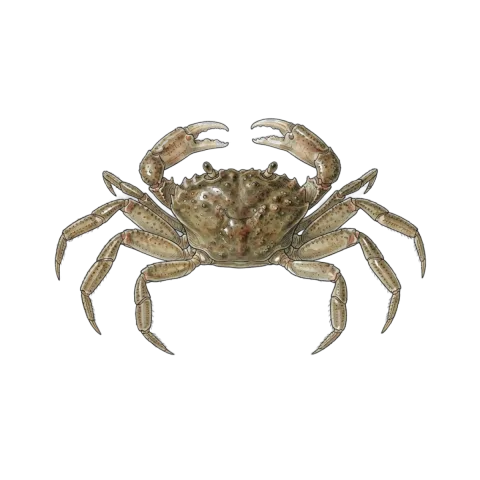
01
Crab
- Bottom Fishing
Hard upper shell protects the crab and anchors its vital organs.
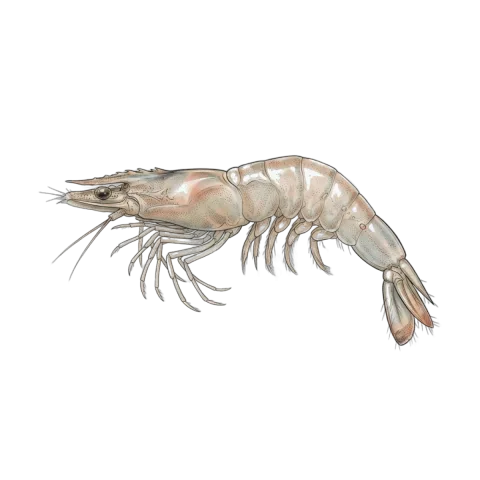
02
Shrimp
- Bottom Fishing
Translucent segmented carapace protects the body.
How Prickly puffer migrates — Inshore–offshore
Shifts between shallow inshore water and deeper offshore grounds with the season.
1 Warm months
Inshore
Stay close inshore through the warm months.
2 Cold months
Offshore
Move offshore into deeper water as it cools.
Hover or tap a number to read each stage.
Diet and behavior of Prickly puffer
-
Diet
Carnivore -
Feeds by
Hunts animals -
Hunts
Morning · Midday -
Feeds over
Hard bottom
Where Prickly puffer lives
Lives on or just above the bottom. Work jigs, bait, and lures along the seabed.
10–100 m

Estuary
Where this species lives
Prickly puffer photos for identification
Compare these photos with the catalog plate to identify the species.