How to catch Reticulated leatherjacket
Stephanolepis diaspros Fraser-Brunner, 1940
About Reticulated leatherjacket fishing
The reticulated leatherjacket is a small marine fish belonging to the filefish family Monacanthidae, easily recognised by its deep, highly compressed body, rough sandpaper-like skin, and a prominent barbed spine on the forehead. Growing up to twenty five centimetres in total length, it features an intricate pattern of brownish-green lines and spots with yellowish fins. Originally from the western Indian Ocean and Red Sea, this species has successfully colonised the eastern Mediterranean through the Suez Canal as a Lessepsian migrant. It inhabits coastal shallow waters down to fifty metres, frequenting rocky substrates, algal forests, seagrass meadows, and sandy bottoms where it forms small groups. The species feeds primarily by browsing on small benthic invertebrates plucked directly from hard structures and vegetation.
-
Difficulty
Medium
-
Average size
15 cm
-
Habitat
Saltwater
-
Season
Spring, Summer, Autumn

Dorsal Spine
Prominent barbed spine on head characterizes filefishes and triggerfishes.
Ocellus Spot
Distinct dark ocellus with a pale margin on the upper flank identifies the species.
Reticulated Pattern
Complex network of brown spots and blotches covers the compressed body.
Reticulated leatherjacket fishing facts
Characteristics
-
Typical size
15 cm (max 25 cm TL ) -
Typical weight
0.2 kg (max 0.2 kg ) -
Preferred temperature
23.5–29.2 °C -
Depth
20–50 m -
Body shape
Short And / Or Deep -
Vulnerability score
29.3
Best hours
-
Low
Dawn
First light
-
Peak
Morning
After sunrise
-
Active
Midday
High sun
-
Peak
Afternoon
Late day
-
Low
Dusk
Last light
-
Low
Night
After dark
When to fish for Reticulated leatherjacket
How to catch Reticulated leatherjacket
Tips for catching Reticulated leatherjacket
Anglers targeting the reticulated leatherjacket usually encounter it while bottom fishing or float fishing around shallow rocky reefs, jetties, and seagrass beds in the eastern Mediterranean. Because these fish possess small, incisor-equipped mouths and feed by delicately nipping at benthic organisms, successful presentation requires extremely small hooks baited with tiny pieces of marine worms or peeled shrimp. Bites are notoriously subtle and fast, often stripping bait without detection unless a sensitive rod tip or light line is monitored closely. Fishing during daylight hours, particularly from late spring through autumn when coastal waters warm up, yields the most consistent activity. Groundbaiting with a fine particle mix can help attract and hold a small group near your swim.
Other names for Reticulated leatherjacket
Local and alternate names anglers use for Reticulated leatherjacket.
-
Reticulated leatherjacket
Best equipment to catch Reticulated leatherjacket
Compare fishing methods for Reticulated leatherjacket — sized kit for each technique.
Note: Typical fish is 0.2 kg Our algorithm will suggest the best equipment for you based on this weight.
Bottom Fishing
Presenting bait or rigs on or near the lake or sea floor.
60% Effectiveness

Rod
Spinning rod
A spinning rod is a fishing rod built to carry a spinning reel under the blank. You cast lures and light baits with it from shore or a boat.
Sized for a typical fish
ultralight · 1.8 m
- Reel seat
- Spinning
- Form factor
- Multi-piece
- Action
- Fast
- Grip
- EVA

Reel
Spinning reel
A spinning reel hangs under the fishing rod and is the default reel for casting lures and light baits. Line peels off an open spool with a bail.
Sized for a typical fish
1000 · 3 kg drag · 185 g
- Spool
- Fixed
- Mount
- Under
- Drag
- Front
- Retrieve
- Manual

Line
Monofilament line
Monofilament fishing line is the everyday main line: easy to knot, cheap to replace, and stretchy enough to forgive a hard strike.
Sized for a typical fish
1.3 kg · 0.125 mm
- Visibility
- Medium
- Abrasion
- Medium
- Stretch
- High
- Sink rate
- Slow

Leader
Fluorocarbon leader
A fluorocarbon leader is the clear, fast-sinking join between a visible main line and the lure or hook.
Sized for a typical fish
4 kg · 0.2 mm · 80 cm
- Visibility
- Very low
- Abrasion
- High
- Stretch
- Low
- Sink rate
- Fast

Hook
Circle hook
A circle hook turns in the mouth and usually finds the corner of the jaw. You do not strike hard — you come tight. It includes freshwater.
Sized for a typical fish
4
- Points
- 1
- Offset
- No
- Barbed
- Yes
- Gap
- Standard
Best lures and baits for Reticulated leatherjacket
Ranked lures and natural baits from every method, best first.
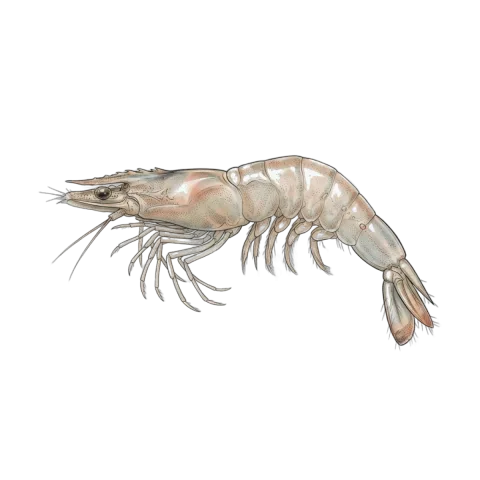
01
Shrimp
- Bottom Fishing
Translucent segmented carapace protects the body.
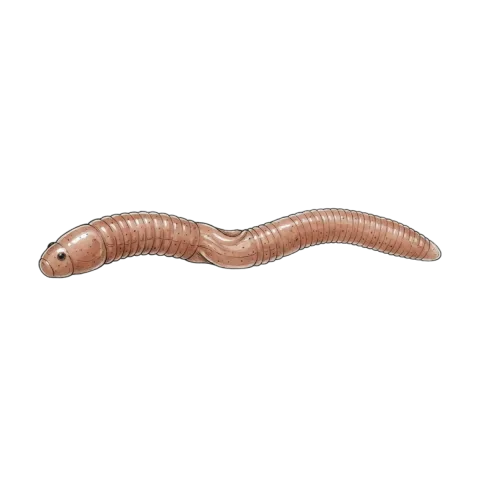
02
Worm
- Bottom Fishing
Rounded anterior end containing the mouth used for anchoring the bait on the hook.
How Reticulated leatherjacket migrates — Inshore–offshore
Shifts between shallow inshore water and deeper offshore grounds with the season.
1 Warm months
Inshore
Stay close inshore through the warm months.
2 Cold months
Offshore
Move offshore into deeper water as it cools.
Hover or tap a number to read each stage.
Diet and behavior of Reticulated leatherjacket
-
Diet
Top predator -
Hunts
Morning · Afternoon -
Feeds over
Hard bottom · Coral reefs
Prey and predators of Reticulated leatherjacket
Prey is what Reticulated leatherjacket eats. Predators are the animals that eat it.
That is how it feeds, and how it is hunted.
Prey
What it eats
Other prey
Where Reticulated leatherjacket lives
Lives on or just above the bottom. Work jigs, bait, and lures along the seabed.
20–50 m

Where this species lives
Reticulated leatherjacket photos for identification
Compare these photos with the catalog plate to identify the species.
Where to fish for Reticulated leatherjacket
Mapped fishing spots where Reticulated leatherjacket is recorded — open a pin for access and methods.
