How to catch Scaled herring
Harengula jaguana Poey, 1865
About Scaled herring fishing
The scaled herring is a small pelagic member of the family Dorosomatidae native to the coastal waters and brackish estuaries of the western Atlantic. Reaching a maximum length of just over twenty centimetres and a typical weight under a fraction of a kilogram, this streamlined fusiform fish features a solid back with dark streaks, a deep compressed belly, and a distinctive dark spot at the edge of the gill cover. It inhabits shallow depths down to twenty-two metres over sandy and muddy substrates, where it forms dense schools. As a fast-growing species with a short lifespan, it feeds primarily on small aquatic organisms and serves as an important link in the marine food web, frequently pursued by coastal anglers seeking prime live or dead bait.
-
Difficulty
Medium
-
Average size
12 cm SL
-
Market value
Low
-
Habitat
Brackish, Saltwater
-
Season
Spring, Summer, Autumn, Winter
-
Also known as
Guiana harring, Hardback herring, Herring, Pilchard, Sardine, Scaled sardine

Forked caudal shape
Deeply forked tail fin typical of pelagic schooling herrings.
Terminal mouth
Terminal mouth position helps identify this herring species.
Straight forehead
More or less straight forehead profile characteristic of scaled herring.
Cycloid scales
Firmly attached cycloid scales cover the deeply curved belly.
Scaled herring fishing facts
Characteristics
-
Typical size
12 cm SL (max 21.2 cm TL ) -
Typical weight
0.2 kg (max 0.1 kg ) -
Preferred temperature
23.2–28.1 °C -
Depth
1–22 m -
Longevity
3 years -
Body shape
Fusiform / Normal -
Commercial?
-
Vulnerability score
20.8
Best hours
-
Active
Dawn
First light
-
Peak
Morning
After sunrise
-
Low
Midday
High sun
-
Peak
Afternoon
Late day
-
Active
Dusk
Last light
-
Low
Night
After dark
When to fish for Scaled herring
How to catch Scaled herring
Tips for catching Scaled herring
Anglers targeting this schooling baitfish typically employ ultra-light spinning tackle outfitted with small sabiki rigs or tiny multi-hook feather strings to match their diminutive size and pelagic habits. Because these schooling herring frequent shallow inshore zones, estuaries, and sandy coastal margins, locating surface ripples or diving sea birds often reveals their tight aggregations. The most productive sessions occur during the warm daylight hours when active schools push close to shore, making early morning and late afternoon the optimal windows for deployment. While rarely targeted for sport alone, their exceptional value as live bait for larger inshore predators makes them a staple target for coastal fishermen using fine-wire loops and careful presentation.
Other names for Scaled herring
Local and alternate names anglers use for Scaled herring.
-
Scaled herring
-
Scaled sardine
-
Pilchard
-
Sardine
-
Herring
-
Hardback herring
-
Guiana harring
Best equipment to catch Scaled herring
Compare fishing methods for Scaled herring — sized kit for each technique.
Note: Typical fish is 0.2 kg Our algorithm will suggest the best equipment for you based on this weight.
Spinning
Casting and retrieving lures with a spinning rod and reel.
70% Effectiveness

Rod
Spinning rod
A spinning rod is a fishing rod built to carry a spinning reel under the blank. You cast lures and light baits with it from shore or a boat.
Sized for a typical fish
ultralight · 1.8 m
- Reel seat
- Spinning
- Form factor
- Multi-piece
- Action
- Fast
- Grip
- EVA

Reel
Spinning reel
A spinning reel hangs under the fishing rod and is the default reel for casting lures and light baits. Line peels off an open spool with a bail.
Sized for a typical fish
1000 · 3 kg drag · 185 g
- Spool
- Fixed
- Mount
- Under
- Drag
- Front
- Retrieve
- Manual

Line
Braided line
Braided fishing line is the thin, no-stretch main for long casts, jigging, and feeling every tick on the retrieve.
Sized for a typical fish
6 kg · 0.1 mm
- Visibility
- High
- Abrasion
- Low
- Stretch
- None
- Sink rate
- Floats

Leader
Fluorocarbon leader
A fluorocarbon leader is the clear, fast-sinking join between a visible main line and the lure or hook.
Sized for a typical fish
7 kg · 0.3 mm · 90 cm
- Visibility
- Very low
- Abrasion
- High
- Stretch
- Low
- Sink rate
- Fast
Best lures and baits for Scaled herring
Ranked lures and natural baits from every method, best first.
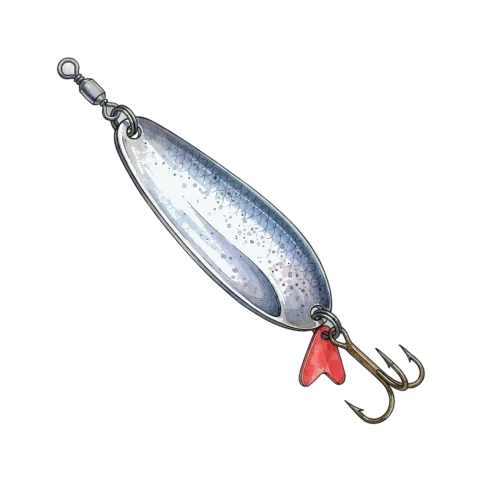
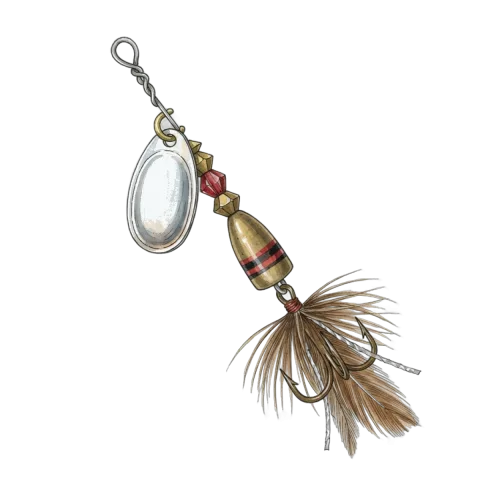
02
Inline spinner
- Spinning
An inline spinner with a blade that flashes on a straight retrieve.
How Scaled herring migrates — Inshore–offshore
Shifts between shallow inshore water and deeper offshore grounds with the season.
1 Warm months
Inshore
Stay close inshore through the warm months.
2 Cold months
Offshore
Move offshore into deeper water as it cools.
Hover or tap a number to read each stage.
Diet and behavior of Scaled herring
-
Diet
Carnivore -
Feeds by
Hunts animals -
Hunts
Morning · Afternoon -
Social
Schooling
Prey and predators of Scaled herring
Prey is what Scaled herring eats. Predators are the animals that eat it.
That is how it feeds, and how it is hunted.
Predators
What hunts it
Where Scaled herring lives
Tied to reefs and rocky structure in shallow coastal water.
1–22 m · usually 1–5 m

Estuary
Where this species lives
Scaled herring photos for identification
Compare these photos with the catalog plate to identify the species.
Where to fish for Scaled herring
Mapped fishing spots where Scaled herring is recorded — open a pin for access and methods.
