How to catch Snow pleco
Pterygoplichthys ambrosettii (Holmberg, 1893)
About Snow pleco fishing
The snow pleco is an elongated armored catfish belonging to the family Loricariidae and the genus Pterygoplichthys, native to the freshwaters of south-central South America including the Rio Plata basin. It features a robust body covered in bony plates, a dark grey ground colour marked with light beige or white blotches, and a distinctive large sail-like dorsal fin. Growing to a maximum total length of nearly fifty-five centimetres and a weight of over two kilograms, this demersal herbivore and detritivore feeds primarily by scraping algae and organic matter from submerged surfaces using its specialized inferior sucker mouth. It inhabits warm tropical rivers and slow-flowing channels, and while primarily established within native South American river basins, it has gained global attention through the aquarium trade and subsequent introduction events.
-
Difficulty
Medium
-
Habitat
Freshwater
-
Also known as
Catfish, Parana sailfin catfish, Royal plec, Southern sailfin catfish

Spotted pattern
Dense dark spots cover the entire body and fins, distinguishing this species.
Sucking mouth
Inferior sucker mouth with barbels adapted for benthic feeding on algae and wood.
Bony scutes
Rows of overlapping dermal plates armour the body typical of loricariids.
Enlarged dorsal fin
Extremely tall sail-like dorsal fin with numerous branched rays.
Snow pleco fishing facts
Characteristics
-
Typical size
54.9 cm TL -
Typical weight
0.4 kg (max 2.3 kg ) -
Body shape
Elongated -
Vulnerability score
60.2
How to catch Snow pleco
Tips for catching Snow pleco
Target this armored bottom dweller by presenting small baits right on the mud or silt where it feeds on organic matter and detritus. Heavy bottom rigs equipped with small hooks and natural offerings work best to reach deep holding areas in rivers and slow moving channels. Focus your efforts during low light periods and warmer months when these catfish are most active along the substrate.
Other names for Snow pleco
Local and alternate names anglers use for Snow pleco.
-
Snow pleco
-
Southern sailfin catfish
-
Royal plec
-
Parana sailfin catfish
-
Catfish
Best equipment to catch Snow pleco
Compare fishing methods for Snow pleco — sized kit for each technique.
Note: Typical fish is 0.4 kg Our algorithm will suggest the best equipment for you based on this weight.
Bottom Fishing
Presenting bait or rigs on or near the lake or sea floor.
70% Effectiveness

Rod
Spinning rod
A spinning rod is a fishing rod built to carry a spinning reel under the blank. You cast lures and light baits with it from shore or a boat.
Sized for a typical fish
light · 2.1 m
- Reel seat
- Spinning
- Form factor
- Multi-piece
- Action
- Fast
- Grip
- EVA

Reel
Spinning reel
A spinning reel hangs under the fishing rod and is the default reel for casting lures and light baits. Line peels off an open spool with a bail.
Sized for a typical fish
1000 · 3 kg drag · 185 g
- Spool
- Fixed
- Mount
- Under
- Drag
- Front
- Retrieve
- Manual

Line
Monofilament line
Monofilament fishing line is the everyday main line: easy to knot, cheap to replace, and stretchy enough to forgive a hard strike.
Sized for a typical fish
2.5 kg · 0.16 mm
- Visibility
- Medium
- Abrasion
- Medium
- Stretch
- High
- Sink rate
- Slow

Leader
Fluorocarbon leader
A fluorocarbon leader is the clear, fast-sinking join between a visible main line and the lure or hook.
Sized for a typical fish
4 kg · 0.2 mm · 80 cm
- Visibility
- Very low
- Abrasion
- High
- Stretch
- Low
- Sink rate
- Fast

Hook
Circle hook
A circle hook turns in the mouth and usually finds the corner of the jaw. You do not strike hard — you come tight. It includes freshwater.
Sized for a typical fish
4
- Points
- 1
- Offset
- No
- Barbed
- Yes
- Gap
- Standard
Best lures and baits for Snow pleco
Ranked lures and natural baits from every method, best first.
01
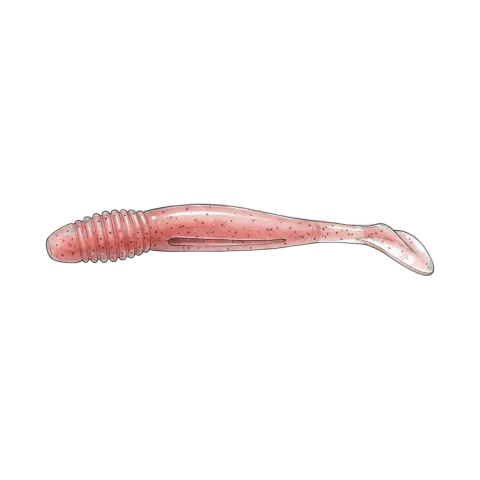
Soft worm
- Bottom Fishing
A long soft worm for Texas, wacky, and ned-style spinning.
Diet and behavior of Snow pleco
-
Diet
Herbivore
Where Snow pleco lives
Lives on or just above the bottom. Work jigs, bait, and lures along the seabed.

Where this species lives