How to catch White sturgeon
Acipenser transmontanus Richardson, 1836
About White sturgeon fishing
The white sturgeon is a massive anadromous fish belonging to the family Acipenseridae, easily recognised by its elongated body, rows of bony ganoid scutes, and a distinctive heterocercal tail. Growing up to a remarkable maximum length of six hundred and ten centimetres and a maximum weight of eight hundred and sixteen kilograms, it features a greyish to brownish back with paler ventral areas and barbels positioned closer to the tip of the snout than the mouth. Primarily inhabiting deep, soft-bottomed estuaries, large rivers, and coastal marine environments across a depth range of one to one hundred and twenty-two metres, this species undertakes extensive spawning migrations upstream into freshwater systems during the spring months. Juveniles feed largely on benthic invertebrates like chironomids and crustaceans, while adults transition to a diet consisting primarily of fishes, making them a legendary target for specialised big-game anglers.
-
Difficulty
Medium
-
Average size
21 cm TL
-
Habitat
Freshwater, Brackish, Saltwater
-
Season
Spring, Summer, Autumn
-
Also known as
Columbia sturgeon, Oregon sturgeon, Pacific sturgeon, Sacramento sturgeon, White Sturgeon

Heterocercal tail
Upper lobe of the caudal fin is elongated, identifying sturgeons.
Bony scutes
Prominent rows of bony shields along the body distinguish it.
White sturgeon fishing facts
Characteristics
-
Typical size
21 cm TL (max 610 cm TL ) -
Typical weight
37.5 kg (max 816 kg ) -
Preferred temperature
8.3–12.2 °C -
Depth
1–122 m -
Longevity
104 years -
Body shape
Elongated -
Vulnerability score
87.4
Best hours
-
Peak
Dawn
First light
-
Active
Morning
After sunrise
-
Low
Midday
High sun
-
Active
Afternoon
Late day
-
Peak
Dusk
Last light
-
Peak
Night
After dark
When to fish for White sturgeon
How to catch White sturgeon
Tips for catching White sturgeon
Targeting this prehistoric giant requires heavy-duty tackle capable of handling immense power and endurance in deep river channels and tidal estuaries. Bottom fishing with robust ledger rigs pinned securely to soft or sandy bottoms is the most effective approach, using large, scent-rich baits such as cut fish, whole lamprey, or squid to trigger their keen sense of smell. Concentrated efforts during the warmer months from late spring through early autumn yield the best results when fish are actively moving and feeding within river systems and coastal bays. Focus your setups around deep holes, current breaks, and structural troughs where large specimens lie in wait for passing prey. Patience is essential, as bites can be subtle pick-ups followed by blistering runs requiring immediate, solid hook-sets.
Other names for White sturgeon
Local and alternate names anglers use for White sturgeon.
-
White sturgeon
-
Sacramento sturgeon
-
Pacific sturgeon
-
Oregon sturgeon
-
Columbia sturgeon
Best equipment to catch White sturgeon
Compare fishing methods for White sturgeon — sized kit for each technique.
Note: Typical fish is 37.5 kg Our algorithm will suggest the best equipment for you based on this weight.
Bottom Fishing
Presenting bait or rigs on or near the lake or sea floor.
90% Effectiveness

Rod
Spinning rod
A spinning rod is a fishing rod built to carry a spinning reel under the blank. You cast lures and light baits with it from shore or a boat.
Sized for a typical fish
extra-heavy · 2.18 m
- Reel seat
- Spinning
- Form factor
- Multi-piece
- Action
- Fast
- Grip
- EVA

Reel
Spinning reel
A spinning reel hangs under the fishing rod and is the default reel for casting lures and light baits. Line peels off an open spool with a bail.
Sized for a typical fish
30000 · 30 kg drag · 1107 g
- Spool
- Fixed
- Mount
- Under
- Drag
- Front
- Retrieve
- Manual

Line
Monofilament line
Monofilament fishing line is the everyday main line: easy to knot, cheap to replace, and stretchy enough to forgive a hard strike.
Sized for a typical fish
130 kg · 1.6 mm
- Visibility
- Medium
- Abrasion
- Medium
- Stretch
- High
- Sink rate
- Slow

Leader
Fluorocarbon leader
A fluorocarbon leader is the clear, fast-sinking join between a visible main line and the lure or hook.
Sized for a typical fish
136.1 kg · 1.885 mm · 180 cm
- Visibility
- Very low
- Abrasion
- High
- Stretch
- Low
- Sink rate
- Fast

Hook
Circle hook
A circle hook turns in the mouth and usually finds the corner of the jaw. You do not strike hard — you come tight. It includes freshwater.
Sized for a typical fish
6/0
- Points
- 1
- Offset
- No
- Barbed
- Yes
- Gap
- Standard
Best lures and baits for White sturgeon
Ranked lures and natural baits from every method, best first.
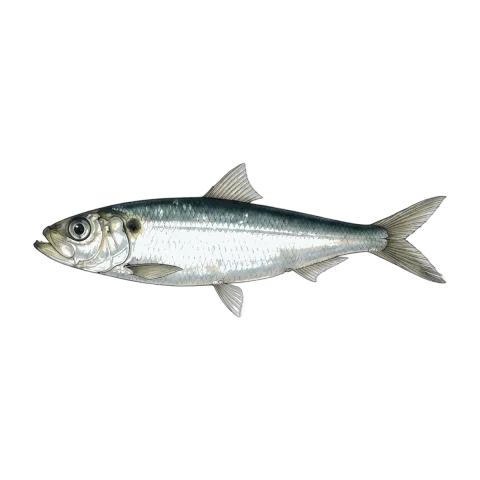
01
Sardine
- Bottom Fishing
Elongated silvery baitfish body releases strong scent trails.
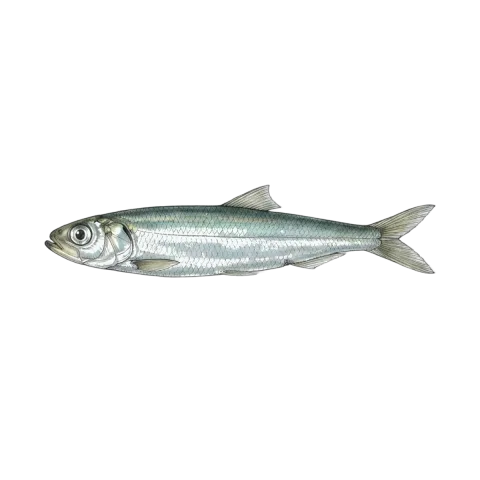
02
Anchovy
- Bottom Fishing
Elongated fish profile attractive for trolling and drift fishing.
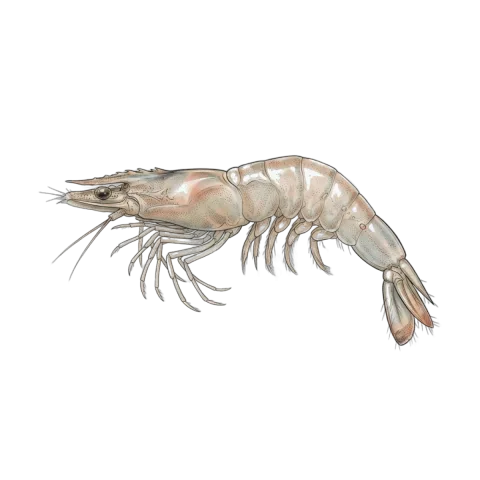
03
Shrimp
- Bottom Fishing
Translucent segmented carapace protects the body.
How White sturgeon migrates — Anadromous
Grows at sea and swims into rivers to spawn. Target the run as fish leave the ocean and push upstream.
1 Eggs
Fresh water
Laid in fresh water, usually well up the river.
2 Juveniles
→ Sea
Grow in the river, then head downstream to the sea.
3 Adults
Sea
Feed and grow at sea.
4 Spawners
→ Fresh water
Run back up the river to spawn.
Some populations never go to sea and complete the cycle in rivers and lakes.
Hover or tap a number to read each stage.
Diet and behavior of White sturgeon
-
Diet
Carnivore -
Feeds by
Hunts animals -
Hunts
Dawn · Dusk · Night -
Main prey
Baitfish
Prey and predators of White sturgeon
Prey is what White sturgeon eats. Predators are the animals that eat it.
That is how it feeds, and how it is hunted.
Prey
What it eats
Predators
What hunts it
Fish
Where White sturgeon lives
Lives on or just above the bottom. Work jigs, bait, and lures along the seabed.
1–122 m

River mouth
Where this species lives
White sturgeon photos for identification
Compare these photos with the catalog plate to identify the species.
Where to fish for White sturgeon
Mapped fishing spots where White sturgeon is recorded — open a pin for access and methods.


